Reub's journey

Showing posts with label Japan. Show all posts

20 August 2012

Dogs of Japan


"Haniwa," A terracotta tomb figurine-dog from 6th century Japan, Tokyo National Museum

When we travel abroad, I always miss Ed and Reub (not the blog, but the dogs) so I end up photographing other peoples' dogs. The trip to Japan in June and July was no exception. They say the Japanese are pet-crazy, so I figured there would be lots of photo opps.  Plus, we were headed straight for Akita Prefecture, the birthplace of the Akita Inu, a breed of spitz fighting dogs.


Faithful Hachikō's statue outside of Shibuya Station: it's the meeting place where thousands of people go every day to wait for friends. Every person in this picture is doing that very thing.

Perhaps you know the true story of Hachikō, Japan's most famous Akita? Here it is, well-stated, from Wikipedia:

He was born in 1923 and owned by Professor Hidesaburō Ueno of Tokyo.[12] Professor Ueno lived near the Shibuya Train Station in a suburb of the city and commuted to work every day on the train. Hachikō accompanied his master to and from the station each day. On May 25, 1925, when the dog was 18 months old, he waited for his master's arrival on the four o'clock train. But he waited in vain; Professor Ueno had suffered a fatal stroke at work. Hachikō continued to wait for his master's return. He traveled to and from the station each day for the next nine years. He allowed the professor's relatives to care for him, but he never gave up the vigil at the station for his master. His vigil became world renowned when, in 1934, shortly before his death, a bronze statue was erected at the Shibuya train station in his honor... eventually, Hachikō's legendary faithfulness became a national symbol of loyalty, particularly to the person and institution of the Emperor.


Odate, Akita Prefecture, is Hachikō's birthplace & all of the manhole covers bear this design.


However, it was days before I saw an actual dog. Where were they?


Could it have something to do with the fact that the dog population of Japan was decimated by World War II? The famine of those years caused dogs to be slaughtered for their meat, their pelts donated to the military. It was illegal to own anything but a German Shepherd. There were very few Akitas left by the end of that war, and many of the survivors were taken back to the US by American soldiers.


At last I saw a real live Akita. In Akita! Happy day.


Still, there were more  canine pictures than actual dogs. This pup was on a forest fire awareness sign, kind of like Smokey the Bear.


Saigo Takamori, the "last samurai" and his dog: a statue in Ueno Park, Tokyo. It is said that the dog  is included in order to soften the image of Takamori, the warrior-poet-politician who committed suicide at the end of the Edo period.


"ADA BAT
You must be udabut life.
Believe my ability."

I lacked the nerve to ask this guy for the shirt off his back.


OK. Now for some real live dogs-of-Japan:


Turns out that dogs are quite expensive. This puppy, for sale in a Tokyo pet shop, cost  $2,400.00.


A little white dog (Maltese?) accompanying a shop-owner to work in Kyoto's Inari shrine.


A lovely black lab, also at work with her owner.


A Pomeranian out for a stroll.


A West Highland terrier at work, pretty comfy on his rug, and taking up a whole booth.


A Kyoto man wearing a traditional summer kimono, with his Corgi on the Philosopher's Walk.


And that's an iPhone attached to his obi.

26 July 2012

Food issues in Japan

When I travel I always love the adventure of trying new foods, and in Japan this happened on a daily basis. Cool, right? I would say that 90% of the time we were amazed and delighted.

 We were after all, in JAPAN, and it was time to appreciate something other than US cuisine.


I didn't notice the "Hair make Master Work" sign until after taking this picture. But ya know, that is SO true.
 Although I distinctly remember craving pizza.


This is a vanilla and green tea ice cream cone. It was great! I imagined getting antioxidants along with my ice cream; this should be served up everywhere.


Grilled eel is a widely-enjoyed food in Japan. I wanted to try it, but I just couldn't. This video, shot at the Tsukiji fish market in Tokyo is why. Eeeeuw. But everybody said it's fantastic, sooo...no, could not do it.


Before we left for Japan, the sponsors of our trip sent us this photograph and asked if we would be interested in eating "mountain yam," the mucilaginous substance depicted in the picture. They were doubtful that many of us foreigners would want to eat it, even though it is considered a very healthful food. John and I were all, like, "Hell, yeah, bring it on!"


Turned out, all 12 of us said the same thing. Look how beautiful it was, this dish called "Tororo." The stack of 3 canisters on the upper right contain grated mountain yam, to be mixed with rice in the empty bowl on the bottom left, and then you stir in the condiments all around. Because this felt like an art project to me, I was ecstatic.


Mountain yam, however, is very much an acquired taste, and there was actually no possible way to make it pretty. This mucous-like mixture, so proudly served, was difficult to choke down. Later when we both said that we had eaten 2/3 of it, our Japanese hosts were thrilled. "That's good!!" they congratulated us. Later I looked it up and found out that it's an important ingredient in Chinese medicine: it tonifies your Qi and is helpful to the spleen. Sounds like a plus to me. But to quote Wikipedia:

 Interestingly, perhaps, this was widely used in the Edo period as a personal lubricant for sexual activities,[dubious ] and it was thus considered improper for it to be eaten by a woman. This aversion also derives from the loud slurping sound one makes when eating it, which is considered to be un-ladylike.[1]


So, in the future I'll just have the burger. Thanks.

S

20 July 2012

Tokyo


Wednesday night in Shinjukyu. I did not go to the Shoe Plaza.
Tokyo is the capital of Japan and the largest metropolitan area in the entire world.


3.5 million people pass through Shinjukyo station every day. That's about the same as the population of the state of Oregon.
It is a mind-boggling urban landscape.


A few years back, when "Lost in Translation" came out, a film about "existential ennui," I said I never wanted to go there.


John joked about buying me one of these adult-sized school girl outfits. "That would be hilarious" is what I said, and I meant it.
Because, seriously, there's some pretty weird shit going on there.


Just the sheer size of it, and the assault to the senses! I took this video, amazed, on a Wednesday evening in the Shibuyu  area of Tokyo, where some of the scenes from "Lost in Translation" were shot.


Those of you who know John will understand why this picture is included.
However.


I completely enjoyed Tokyo, although I was exhausted by it.


Of course it's not all neon lights. There are parks and museums, neighborhoods and interesting things to see and do, just like any big city. Take the Tsukiji fish market for example: a complex of enormous warehouses that open at 4:00AM to sell seafood.


Better watch out, or you'll get run over by one of these.
It's the largest wholesale fish market on the planet.


This is salmon roe. It probably came from an Alaskan boat.


Buyers come from all over Japan every morning, but they also come from other countries. Some buyers come from the US, buy fish here in Tokyo that was caught in Alaska, and resell it in the US to sushi restaurants.


Pretty crazy.


And probably not sustainable.


The vast array of sea life sold here was rather sobering.


I'm not sure how you eat these, but obviously you can.


The market has hundreds of accountants and merchants.
It did make me wonder what it would be like if we had a similar market in the US. How vast a quantity do we reap from the sea on a daily basis? What would that actually look like?


A worker, pausing for lunch. The market is closed by noon. (John's photo)
Meanwhile the Tsukiji market goes on day after day, as it has for many many years in this island nation.

Tokyo is a combination of many things and it would take a lifetime to understand it.

18 July 2012

Trains in Japan

John's photo
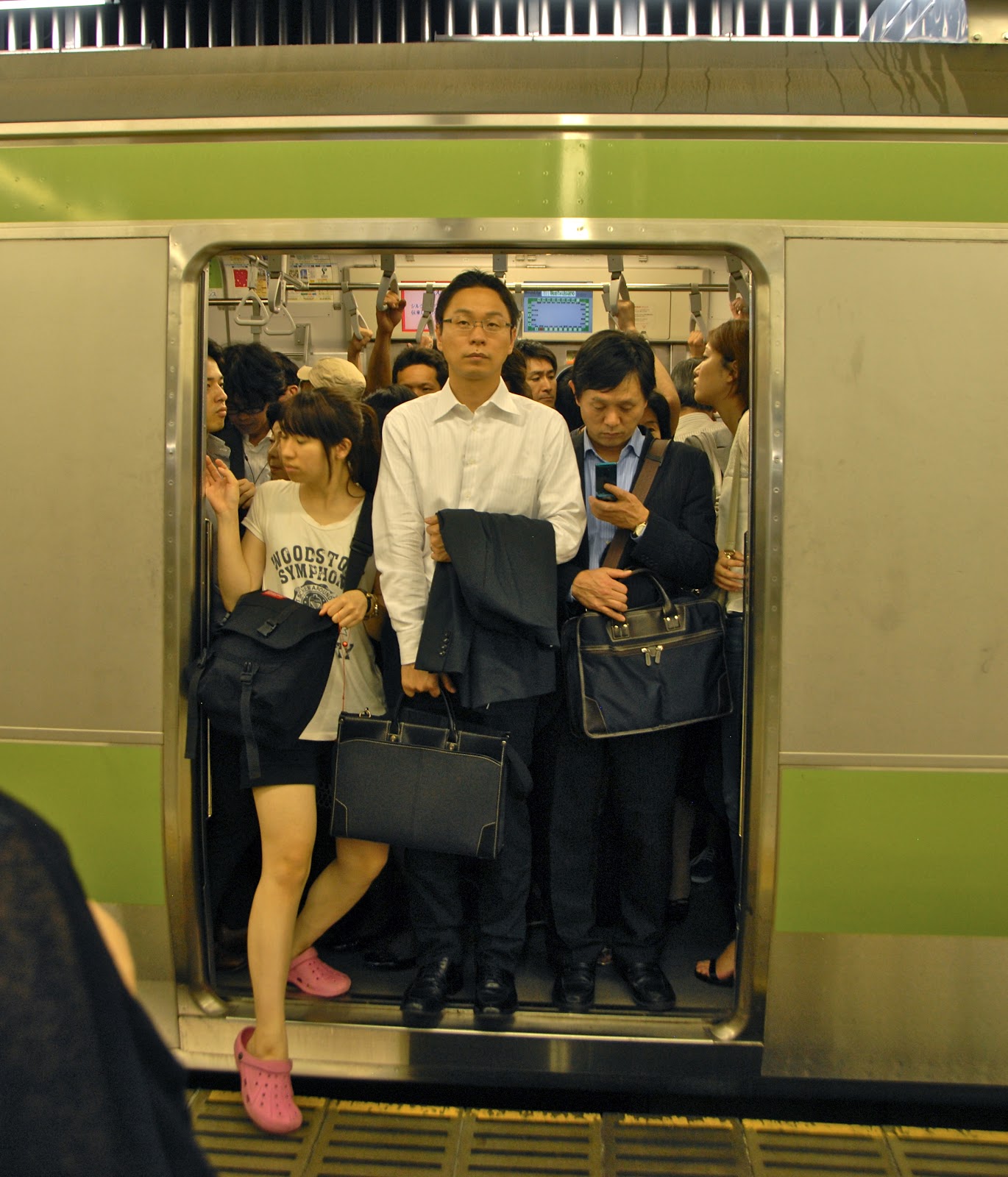
Trains in Japan are amazing. I loved them, although as you see here it is a challenge to be on  a commuter train in Tokyo during rush hour.  Nobody looks at anybody else, there's always room for one more, and during rush hour there are women-only cars (so that the crush doesn't become a grope). After John took this picture I counted at least 5 more people getting aboard!


Our rail pass took us all over the place. John decided to order beer and nuts on the Shinkansen ("bullet train"), just like the Japanese businessmen. Yep, that's us, fitting in with the locals. The bullet trains were so great.


Since we're probably going at least 150mph, I suppose this 30-second video covers at least 2 miles. It was taken out the window about an hour north of Tokyo  and shows a few things: the train's quietness, it's speed, and the unbroken urban development that extends for hundreds of miles north and south of Tokyo.


 And then there is densely-packed Tokyo itself. Here we are, rolling into Tokyo station.


 Check out this series of 3 pictures taken in Tokyo station as we waited for an incoming train:

You know it's about to arrive when the spiffy-looking clean-up crew appears.


Everybody in their places. Checking the time. The train will not be late.


And arriving passengers are always greeted with a bow: this happens in bus stations too. I was astonished by this! Nobody had ever bowed to me on public transportation before. And unless I go back to Japan it will probably never happen again.


16 July 2012

Kyoto temples and gardens

 Kyoto, Japan, was supposed to be a target for an atomic bomb during WWII but Henry Stimson, US Secretary of War, took it off the short list, replacing it with unfortunate Nagasaki.

Shrine at Fushimi-Inari, Kyoto
And that is why there are still places like this, the Fushimi Inari shrine in southern Kyoto, all set about a 230 meter hill, and dedicated to Inari, the fox-goddess of rice and sake.


I loved the thousands of vermillion gates leading up the hill.


And the little wooden fox heads that you could buy and draw upon. I looked at the back of the one in the lower center of this photo.


Looks like it was from a little girl in South Pasadena. But what was her wish? I couldn't quite figure it out.


There was calligraphy on each gate post and this fellow was touching it up.


John's photo
There were thousands of individual shrines crowding the upper part of the hill. John commented that it's hard to get a picture capturing the cacophony of the place, but I think he comes close here: foxes, shrines and gates everywhere.


And once in awhile a big horse.


John's photo
One day we used our rail pass to go from Kyoto to Nara. This temple, Todaiji, is the largest wooden structure on the planet and houses a Daibutsu (Great Buddha).


This humongous structure was begun in the 700's by Emperor Shomu, back when Nara was Japan's capital.


The grounds surrounding Todaiji are populated by hundreds of deer, completely untroubled by the crowds of people.


Apparently they aren't always so docile.


We were there on a Saturday, and there were many groups of school children on field trips.


Nara's Daibutsu is the largest bronze Buddha in the world. Big big big!


One of his fingers is about my size, and I'm 5'7".


What is it about the dance between religion and power that creates these huge monuments?


Roof detail of a smaller shrine in Nara.
I don't know the answer to that, but I was glad that we went to see Nara. It is amazing and fully deserves to be the UNESCO World Heritage site that it is.


John's photo. His lens had begun to fog up, creating this gorgeous effect.
Back in Kyoto, we walked up the hill from our inn to see Kiyomizu, a very atmospheric temple in the clouds and rain.


Holy cow, did it ever pour.


On a clear day you would get a great view of the city from here, but this is what it looks like in the rain.


All of the temples had incense available. My stick is the crooked one, bottom left.


OK, I'm almost done, but first I have to show you the Silver Pavilion, which is set in the most beautiful landscape. The Japanese travel here twice a year, spring and fall, to take in its loveliness and color.


The zen garden behind the Silver Pavilion is re-worked for those two seasons, and allowed to slowly melt into itself in the months between. Here we see what it looked like for the spring of 2012.


I was mesmerized by the dragon's back: so cool, but deceptively hard to photograph!


After looking at the zen garden we traversed the Philosopher's Walk, a dreamy cherry-tree-lined path along a canal. Along its 2K there were more shrines and sights.


But by this time my head was pretty much filled and I was becoming templed-out.  Each shrine is special and to do it justice you should have a fresh mind. Besides, it's good to leave something for next time, right?